
Les Jardins de Métis (Reford Gardens) at 100
Elsie Reford’s gardens are celebrating their 100th birthday in 2026. That her gardens have survived to 100 is worthy of celebration. When I wrote Des jardins oubliés 1860-1960 for Les Publications du Québec in 1999, I discovered dozens of gardens in every region of Quebec, each one remarkable in size and ambition. But by the time Quebec embraced the preservation of historic buildings and its built heritage in the 1960s and 70s, almost of its historic gardens were gone, subdivided, built over, neglected or abandoned. With a few exceptions, Quebec’s garden heritage survives mostly in black and white photographs in a family album or public archive.
The transition of a large garden from one owner to the next is a road full of obstacles. Gardens are necessarily fragile, the plants requiring care and protection, the structures and hardscapes subject to the elements. If Elsie Reford’s gardens survived her departure in 1958, it was the result of a seed sown decades earlier.
Alexander Reford
Great-grandson of Elsie Reford, director 1995-2025, Reford Gardens, and director, Festival international de jardins
Private gardens
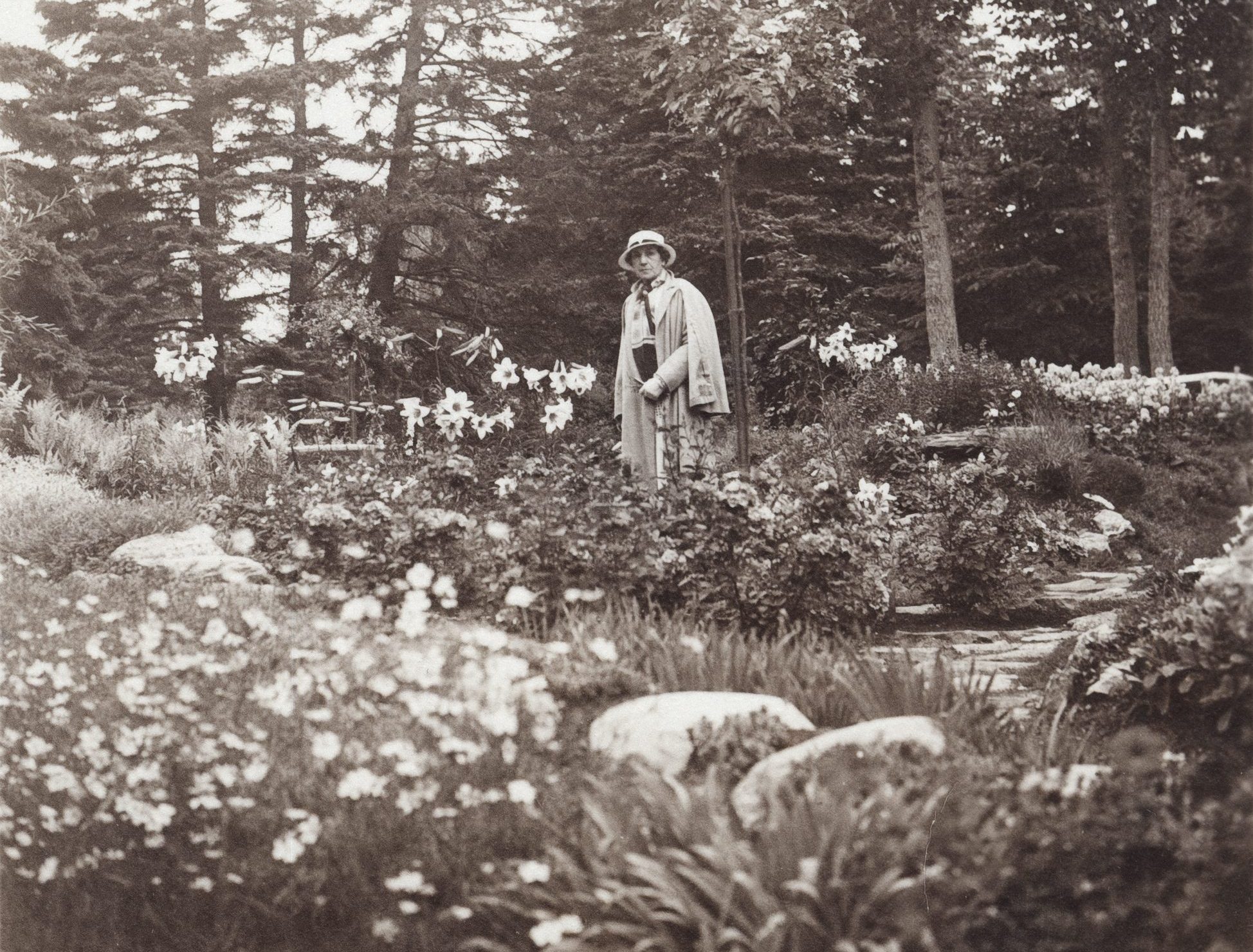
Elsie Reford (1872-1967) began transforming her summer estate in Grand-Métis into a garden during the summer of 1926. Recovering from surgery after having her appendix removed, her doctor ordered her off the river, suggested gardening as a less demanding activity than fishing for salmon while standing in a canoe. Her gardens were always a private paradise. Unlike her contemporary Jennie Butchart (1865-1950) in British Colombia, she never imagined them to be open on a regular basis.
The Montreal Gazette was the first to make the public aware of their existence in August, 1935: “The garden has been cunningly devised. It lies about a little purling trout stream that is crossed by rustic bridges and it offers every conceivable color and an infinite variety of blooms. It reaches out in unexpected ways to places of new beauty, or it follows a flagged walk, flanked by tall hedges, beyond which are the white horses that, wind-driven and sparkling in the sun, tread the blue waters of the Gulf. Mrs. Reford spends much of her time and in it finds never ending interest and pleasure. And who would not? There are English lilies there, with petals delicately streaked with pink, a Japanese iris in mauve and cream, and in a little corner, there grows a rose of ivory so perfect in form and texture and coloring as to be unforgettable. And these are but a few among many, so many that the visitor turns again and again from one new glory to another in delightful bewilderment.”1
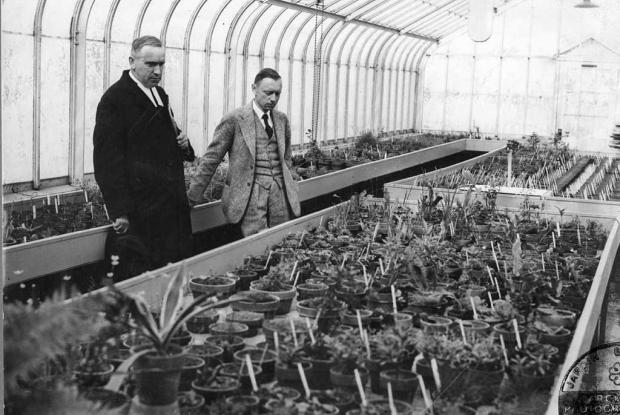
Reserved for her family and guests, Elsie Reford opened what she described as her “lily garden on the Lower St. Lawrence” just once, in aid of air raid victims during the Second World War. She did however welcome garden experts. The most important to visit was Henry Teuscher (1891-1984). The German-born landscape architect had been recruited from the New York Botanical Garden by Frère Marie-Victorin (1885-1944) in 1936 to design and oversee the construction of the Montreal Botanical Garden. Teuscher stopped at Elsie Reford’s gardens in July 1941 en route to the Baie-des-Chaleurs for his summer holiday. Teuscher’s visit sparked his enthusiasm. So began the first of many plant exchanges and visits. Teuscher included her garden in talks he gave in Montreal and the United States on the gardens of Quebec, where he described her gardens as one of the “most remarkable in North America”. Elsie Reford selected more than seventy slides for his presentation. It was probably Teuscher who suggested the inclusion of her gardens in the 1953 coffee table book by Robert Jackson, Beautiful Gardens of the World, their first entrance onto the world stage.
Public gardens out of necessity
If Elsie Reford had planted the seed, it was her daughter-in-law, Elspet Reford, who completed the harvest. Elspet Fraser-Stephen (1908-1965) married Elsie’s eldest son, Bruce Reford (1895-1972), in 1954. Bruce had grown up summering in Metis as a boy, but from the age of 8 he lived mostly in England, first at boarding school, then Rugby School and Oxford University, which he left to join the army in 1914 soon after war was declared. He returned to Canada after a thirty-year career in the British Army, a gallant Brigadier, medaled but without a home.
Elsie Reford gave her fishing lodge and gardens to Bruce Reford in 1954. Historian and author, Elspet Reford ran the household accounts and discovered the growing gulf between his income and the cost of running the gardens and farms. “Having had to spend a great deal on it already, I cannot afford to keep up the garden any longer, and if nothing can be done the weeds will take over”, Bruce Reford wrote. Elspet Reford began efforts to find a buyer for the gardens, understanding their importance and seeing an opportunity. She found an ally in Henry Teuscher.
Teuscher was nearing the end of his long career at the Montreal Botanical Garden but was still a major figure in the world of horticulture. He wrote a brief testimonial of the “Domaine Reford at Grand-Métis”. He spelled out an ambitious plan for the gardens to become a botanical outpost for the Montreal Botanical Garden and an international centre for experimenting with Nordic plants. “In a very short time, the Reford Domaine could be turned into an even finer show place than it is now, and many plants could be seen and studied there which are not in cultivation anywhere else in North America,” Teuscher wrote. Elspet Reford took his endorsement to the local newspapers, obtaining a generous write-up in Le Progrès du golfe in June, 1959. She organized the first open garden day in August, 1960. She was making the case that the gardens should be preserved and that the Quebec government was best placed to assure their development.
State gardens
Quebec’s political landscape was changing. Bruce and Elspet Reford had initiated discussions with the Union Nationale government, but they were cut short with the death of Maurice Duplessis (1890-1959) in September 1959 and his successor Paul Sauvé (1907-1960) just 100 days later. Jean Lesage (1912-1980) and his government was elected in June, 1960. Elspet Reford sent Teuscher’s plan to various officials. When nothing happened, she enlisted his support: “Although there have been many suggestions for the use of the place – as a camping site for example, or a fishery research station – we have always stressed the primary importance of preserving the unique garden,”2 she wrote.
The new government was looking to boost tourism and invest in the Gaspésie. Lionel Bertrand (1906-1979), Provincial Secretary, the ministry then in charge of tourism, announced in July 1961 the imminent purchase of the property. Soon after, the director of the Montreal Botanical Garden, André Champagne (1915-2000), offered the services of Henry Teuscher as “horticulteur-consultant” and to gift plants. Bertrand confirmed the acquisition of the gardens by l’Office du tourisme de la province de Québec in September : « Il s’agit là de la première décision majeure prise en vue de doter les circuits touristiques du Québec d’un réseau de terrains de campisme, » the government press release proclaimed. The headline in the local newspaper signalled the future of the gardens as a tourist attraction, “Grand-Métis: premier poste touristique du grand réseau gaspésien.”3 While the price was not announced, it was $85,000 (2026 : $906,300).
The Quebec government saw the gardens as a new tourism “pôle” with multiple mandates, not solely as a garden attraction. A museum was suggested for the 1887 fishing lodge; camping was to be developed on the land on the west side of the Metis River. Picnic areas were to be landscaped along the St. Lawrence, where Price Brothers had long had their operations. The ambiguity over the mission lingered for several months. But with the hiring of Henry Teuscher early in 1962 by the Office du tourisme as a consultant to develop plans, the mission of the gardens as a horticultural destination was sealed. Teuscher rapidly got to work to inventory the plants. He oversaw the modification of the pathways, widening them to six feet so that visitors could walk two astride. He wisely kept on Elsie Reford’s head gardener, Wyndham Coffin (1893-1980), who shared his lifetime of knowledge. Teuscher created a continuous path from the entrance to Estevan Lodge. Care was taken to protect Elsie Reford’s flowerbeds and plant collections, each bed specifically designed by her to provide the ideal growing conditions for rare species.
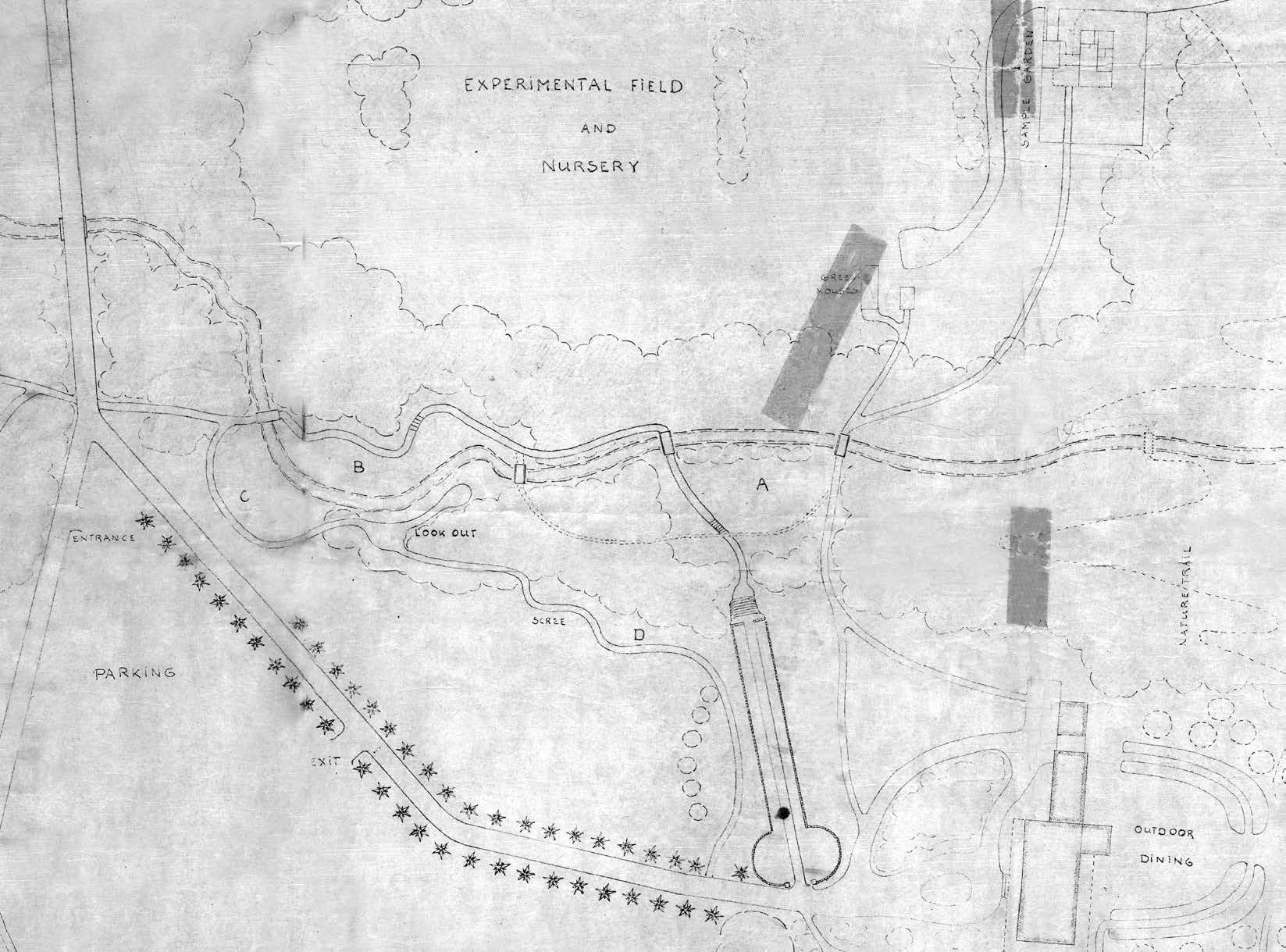
Teuscher brought his acquaintance with the site and its owner to guide its rapid transformation. He also mapped out future development. Parking inside the property should be made impossible; a parking lot was to be built on land acquired to connect to Route 6, protecting the historic property and encouraging travelers to stop. He proposed moving the greenhouse from the remote vegetable garden to a flat space near the guardian’s house. He advocated preserving Elsie Reford’s collections, while adding to them. He designed a bog garden and irrigation pond, planted with indigenous plants sourced nearby and from the Montreal Botanical Garden, one of many signs of Teuscher’s capacity to anticipate horticultural innovation. Sadly, his mandate ended in 1962. While his plans formed the basis for the transformation of Elsie Reford’s gardens into Les Jardins de Métis, his grand ambition to create a Nordic botanical garden and centre for experimentation ended with him.
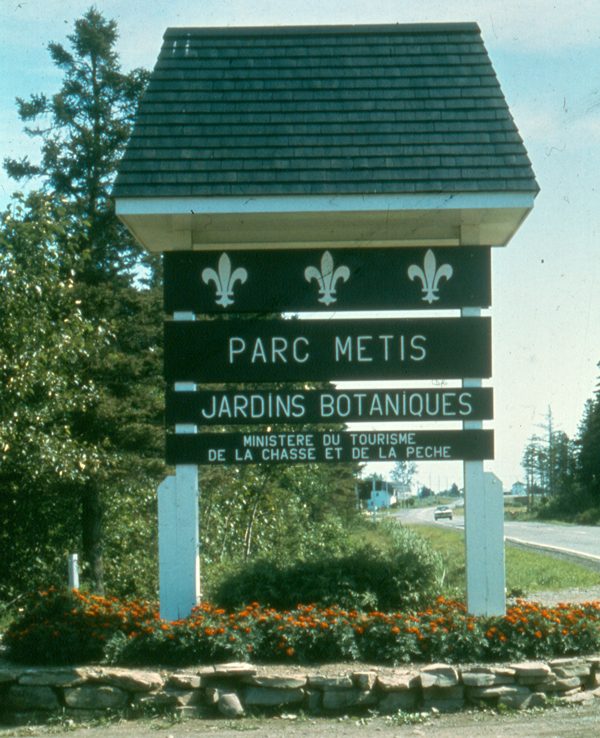
The gardens opened to the public for the first time in 1962 on the Fête de la Saint Jean Baptiste. The symbolism of the date was not lost on local media, who celebrated the province giving the public access to what had hitherto been all too private property. Premier Lesage visited with his wife weeks after the opening. The gardens were immediately popular, drawing as many as 1,000 visitors a day in opening year. With little or no publicity and only rudimentary facilities, le Domaine Reford quickly become one of the must-see attractions on the popular Gaspé tour.
If the success of the gardens surprised the government, its positioning remained unclear. The site went through three name changes in two decades, Domaine Reford, Parc Métis and finally, from 1980, Les Jardins de Métis. The gardens had several directors, the longest-serving of whom, Fernand Lavoie (1942-2023), was among the first hires in 1962. His horticultural experience was vital to keeping the gardens on mission as governments changed, priorities shifted and conservation principles evolved.
Public private gardens
The shifting priorities were made evident in June, 1994, when the government of Quebec announced the sale of the gardens. Their privatization, along with the sale of the Aquarium du Québec and the Jardin zoologique du Québec, was a budgetary exercise for the short-lived government of Liberal premier Daniel Johnson. But it was also a sign that government was exiting the management of tourism attractions. The announcement created a firestorm of local protest, but the government confirmed the sale to Les Amis des Jardins de Métis just days before their electoral defeat. This charitable organization, founded by Les Ateliers Plein Soleil and descendants of Elsie Reford to save the gardens and preserve Estevan Lodge and its museum, has owned and managed the gardens ever since.
Elsie Reford never imagined her private paradise as a public garden. The creation and preservation of Les Jardins de Métis is unique in the annals of gardening. Her legacy lives on, a powerful symbol of a woman’s genius to create a place of beauty that her successors have been eager to protect and share.
For more on Elsie Reford and her gardens, consult: Alexander Reford, « Elsie Reford : exotique et naturalisée », Magazine Gaspésie, vol. 60, no 1 (206), printemps 2023, p. 37-40.
Notes
1. “A Seaside Garden”, Montreal Gazette, August 31, 1935.
2. Elspet Reford to Henry Teuscher, December 13, 1960; Archives Jardin Botanique de Montréal.
3. Le Progrès du Golfe, 22 septembre, 1961.
Photos (in order)
Elsie Reford in her gardens surrounded by lilies, circa 1935.
Photo: Robert W. Reford
Collection Les Amis des Jardins de Métis
Frère Marie-Victorin and Henry Teuscher in a greenhouse at the Montreal Botanical Garden, 1936.
Université de Montréal, Division de la gestion de documents et des archives. Collection Les archives au grand jour. E01185FP009961
Henry Teuscher, excerpt from the Grand Metis Botanical Garden plan, 1962.
Collection Les Amis des Jardins de Métis
Sign at the entrance to the botanical gardens, then known as Métis Park, 1975.
Photo: François Lessard
ANQ Québec. E10,S44,SS1,D75-422,PE1
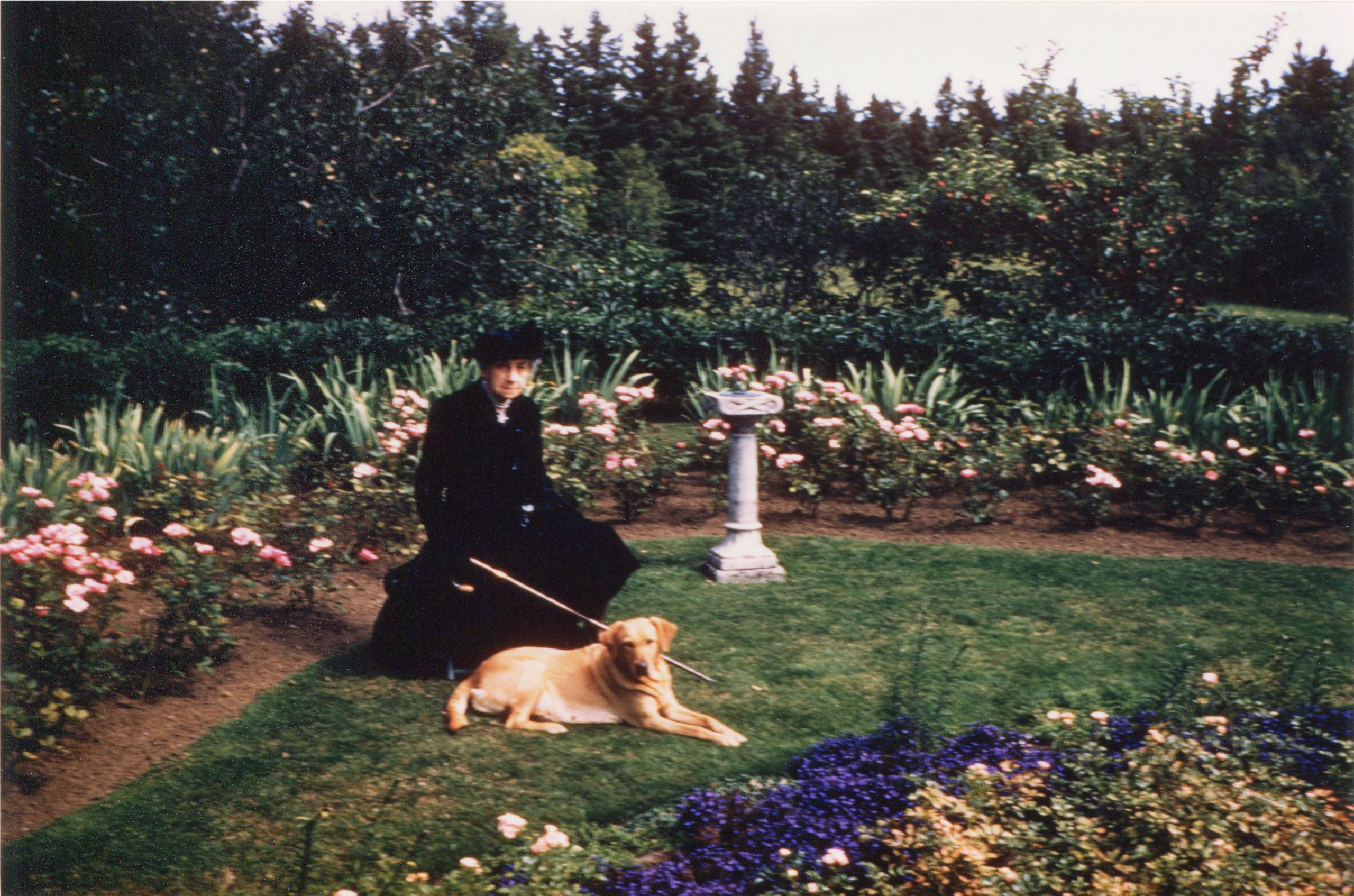
Elsie Reford and her dog in the gardens, circa 1958.
Collection Les Amis des Jardins de Métis